Understanding Personal Installment Loans
A comprehensive consumer overview of installment loan structures, rates, terms, and how they compare with other credit types.
What Makes Installment Loans Distinct?
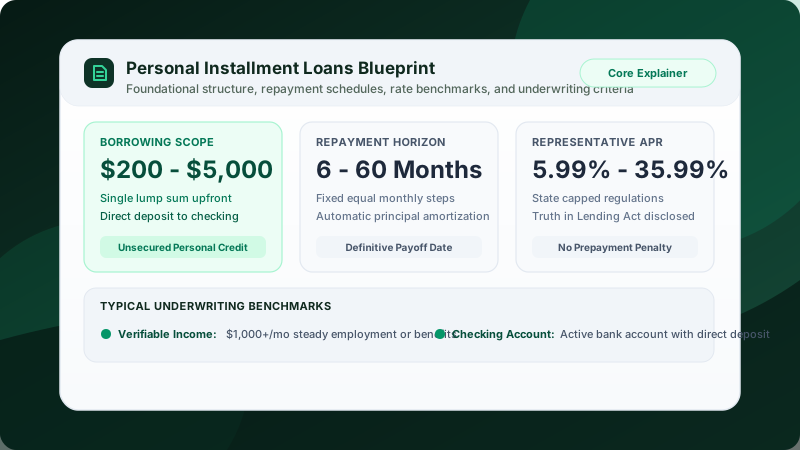
In consumer finance, a personal installment loan is an agreement where a borrower receives a single lump sum of capital upfront and repays that amount over a specified period in equal, scheduled payments.
Each monthly payment is calculated so that by the end of the agreed term (commonly 6 to 60 months), both the principal amount borrowed and the accrued interest are completely satisfied. This predictability helps consumers budget without having to worry about fluctuating minimum payment obligations.
Credit Comparison Matrix
| Feature | Installment Loans | Credit Cards (Revolving) | Short-Term Payday Loans |
|---|---|---|---|
| Disbursement | Single lump sum ($200–$5,000) | Revolving line of credit | Small single sum ($100–$500) |
| Payment Structure | Fixed equal monthly payments | Variable minimum payments | Single balloon payment in 14–30 days |
| Repayment Term | 6 to 60 months | Indefinite (revolving) | 2 to 4 weeks |
| Representative APR | 5.99% to 35.99% | 18% to 29.99%+ | 300% to 500%+ (extreme cost) |
| End Date | Definitive maturity date | No fixed payoff date | Next pay cycle |
Installment Loan Rates and Terms
On this site, we reference an advertised range of $200 to $5,000 in principal, with APRs ranging from 5.99% to 35.99% across 6 to 60 months.
These metrics serve as illustrative guideposts. Your specific offer will be determined by participating lenders after analyzing several risk factors:
- Credit History & Score: Applicants with established credit profiles typically unlock lower APRs, while those with limited credit or past delinquencies may receive offers on the higher end of the APR range.
- Debt-to-Income (DTI) Ratio: Lenders assess your recurring monthly debt commitments compared to your gross monthly income to evaluate your capacity for additional obligations.
- State Statutory Limits: Many U.S. states cap maximum interest rates or loan terms for personal unsecured borrowing.
Evaluating Installment Loan Options
When you receive one or more loan offers, compare more than just the monthly payment. A smaller monthly installment might look attractive, but stretching a loan across 48 or 60 months significantly increases total interest costs over time. Use our payment calculator to test different scenarios before committing.