Juggling multiple credit card bills each month with differing due dates and high double-digit APRs is one of the leading drivers of household financial stress. Consolidating into a single personal installment loan can simplify life, but only if the math works in your favor.
1. How Debt Consolidation Works
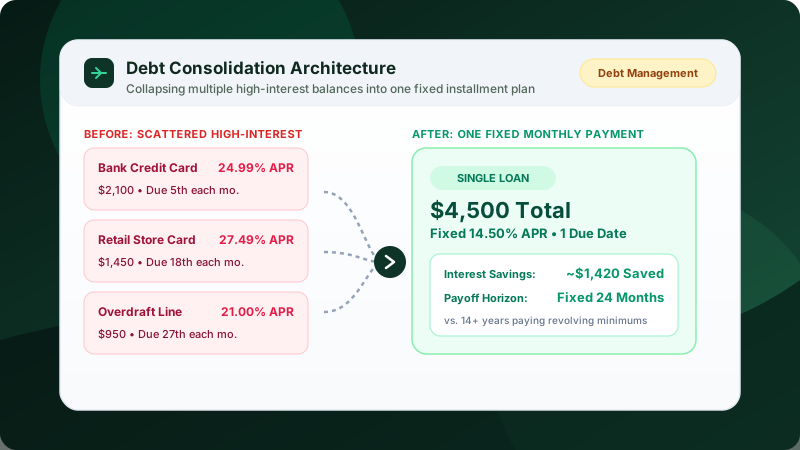
Debt consolidation is the process of taking out one new loan with a fixed interest rate and using the proceeds to immediately pay off several higher-interest revolving debts (such as retail store credit cards, general credit cards, or medical bills).
Instead of sending payments to four different creditors with varying minimum payment amounts that shift every month, you make one fixed monthly payment on a predetermined schedule with a definitive payoff date (such as 24 or 36 months).
2. The Real Math: Comparing Interest & Time
Consider a typical consumer carrying $4,500 in total credit card debt across three cards with an average APR of 26.99%. Compare making minimum payments versus an installment loan:
| Repayment Strategy | Monthly Payment | Time to Debt-Free | Total Interest Paid | Total Out-of-Pocket |
|---|---|---|---|---|
| Minimum Card Payments (26.99% APR) | ~$135 (declining) | 14+ Years | $5,180 | $9,680 |
| Installment Loan (16.99% APR, 36 Mo) | $160.33 (fixed) | 3 Years | $1,272 | $5,772 |
| Installment Loan (14.99% APR, 24 Mo) | $218.06 (fixed) | 2 Years | $733 | $5,233 |
3. When Consolidation Makes Sense
Consolidating high-interest balances is strategically advantageous when:
- The New Loan APR is Substantially Lower: You secure an interest rate that is at least 4% to 8% lower than your current credit card interest rates.
- Your Monthly Cash Flow is Stable: You can reliably afford the fixed installment payment each month without straining other basic necessities.
- You Have a Fixed Payoff Goal: You want a firm date when your debt will be completely gone, rather than an open-ended revolving line.
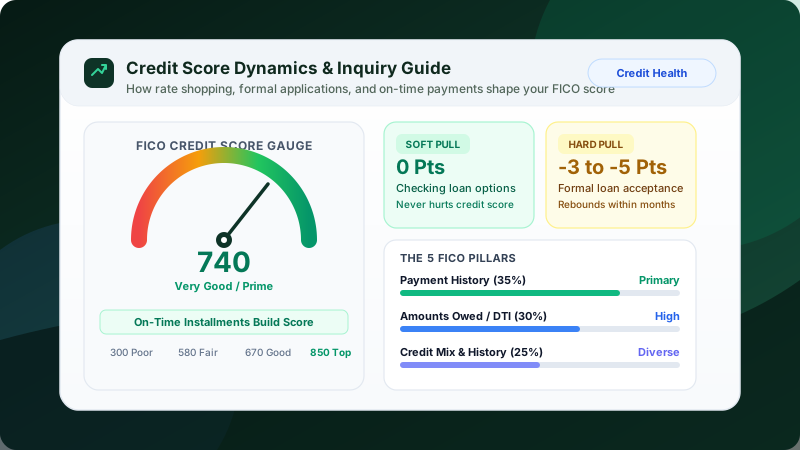
- You Want to Boost Your Credit Score: Paying off card balances drops your revolving credit utilization ratio, which can yield a rapid score improvement.
4. When You Should NOT Consolidate
Consolidation is not a silver bullet. You should avoid it if:
- The New Rate is Higher: If credit score challenges mean the only available installment loan carries an APR higher than your existing cards, consolidation will increase your costs.
- Underlying Spending Habits Haven't Changed: If you clear $4,500 off your credit cards and continue charging purchases on those zeroed-out cards, you risk doubling your total debt load.
- Total Debt Exceeds 50% of Your Annual Income: In cases of severe debt overload, a loan is unlikely to solve the underlying insolvency. In this situation, accredited nonprofit credit counseling (such as the NFCC) or debt management plans are much safer paths.
5. Snowball vs. Avalanche vs. Consolidation
If taking out a new loan is not appropriate, consider these self-directed debt payoff strategies:
6. 4-Step Consolidation Action Plan
- List Every Balance and Rate: Write down each credit card balance, current APR, and monthly minimum payment.
- Calculate Total Payoff Needed: Sum up the balances to determine the exact loan amount required.
- Compare Loan Options: Use our loan calculator to verify that the prospective monthly installment fits comfortably into your budget.
- Freeze Old Card Use: Keep paid-off cards open to protect your average account age, but remove them from online shopping autofill to avoid recharging.
Simulate Your Debt Payoff
Test your consolidation loan figures with our free payment calculator or check eligible options.