When evaluating personal installment loans, the single most critical figure to examine is not the monthly payment or the advertised nominal interest rate—it is the Annual Percentage Rate (APR).
1. What is APR (Annual Percentage Rate)?
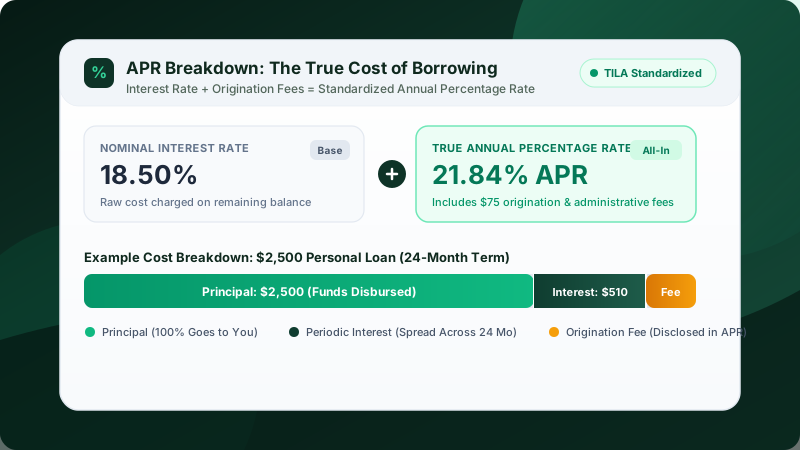
APR represents the standardized annualized cost of borrowing credit expressed as a yearly percentage. Unlike a simple interest rate, APR provides an apples-to-apples metric because it incorporates both the lender's interest rate and all upfront prepaid finance charges (such as administrative or origination fees) required to obtain the loan.
The federal government mandated APR disclosure through the Truth in Lending Act (TILA) in 1968 precisely to prevent lenders from masking the true price of credit behind low advertised interest rates accompanied by inflated hidden setup charges.
2. Interest Rate vs. APR: Why They Differ
Many borrowers mistakenly treat "interest rate" and "APR" as interchangeable terms. They are not:
- Nominal Interest Rate: The percentage of the principal balance that the lender charges each period as cost of capital.
- Annual Percentage Rate (APR): The complete, total annualized financial burden, which includes the interest rate plus upfront origination fees, document preparation fees, and mandatory financing charges.
If a lender charges zero origination fees or prepaid finance charges, the nominal interest rate and the APR will be identical. However, if a lender charges an origination fee (for example, 4% deducted from your payout), the APR will be higher than the interest rate.
3. How Origination Fees Alter Borrowing Costs
Suppose you apply for a $2,500 installment loan with a 15% interest rate repaid over 24 months. If the lender deducts a $125 origination fee (5%) before transferring funds to your account, you only receive $2,375 net cash in hand, but you still repay the loan based on the full $2,500 principal.
Because you received less money while paying interest on the full amount, the true mathematical cost of borrowing increases. Under federal disclosure regulations, the lender must display the resulting APR (approximately 19.8% in this case) clearly on the loan agreement.
4. Real-World Comparison: $2,500 Loan Scenarios
To understand how APR and loan term affect your monthly cash flow and total interest, review this representative comparison for an illustrative $2,500 personal installment loan:
| Loan Amount | Illustrative APR | Term | Monthly Payment | Total Interest Paid | Total Repayment |
|---|---|---|---|---|---|
| $2,500 | 9.99% | 12 Months | $219.78 | $137.36 | $2,637.36 |
| $2,500 | 18.00% | 24 Months | $124.96 | $499.04 | $2,999.04 |
| $2,500 | 24.00% | 36 Months | $98.24 | $1,036.64 | $3,536.64 |
| $2,500 | 35.99% | 36 Months | $116.82 | $1,705.52 | $4,205.52 |
5. Your Legal Rights Under the Truth in Lending Act
Before signing any personal loan agreement, federal law (Regulation Z of the Truth in Lending Act) requires the lender to furnish a standardized disclosure box known as the TILA Box. This box highlights four essential figures:
- Annual Percentage Rate (APR): The true cost of your credit as a yearly rate.
- Finance Charge: The exact total dollar amount the credit will cost you (interest + origination fees).
- Amount Financed: The dollar amount of credit provided to you or on your behalf.
- Total of Payments: The full dollar amount you will have paid after making all scheduled payments as agreed.
6. Pre-Signing Checklist for Borrowers
Before committing to any loan contract, verify these items:
- Confirm Prepayment Penalty Policy: Does the lender penalize you for paying extra principal or settling the loan early? Reputable lenders never charge prepayment penalties.
- Review the Late Payment Fee: What is the grace period (typically 10-15 days), and what is the fee if an ACH debit fails or is returned?
- Test Affordability: Will the scheduled monthly payment leave sufficient surplus in your account for groceries, utilities, and emergency expenses?
Calculate Your Exact Loan Payments
Use our interactive payment calculator to test different loan amounts, terms, and APRs in real time.