When an urgent expense strikes, borrowers frequently encounter two popular short-to-medium-term credit products: installment loans and payday loans. While both provide fast access to funds, their repayment structures and consumer protections couldn't be more different.
1. The Fundamental Difference in Loan Structure
The core divergence between an installment loan and a payday loan lies in how and when you repay the money:
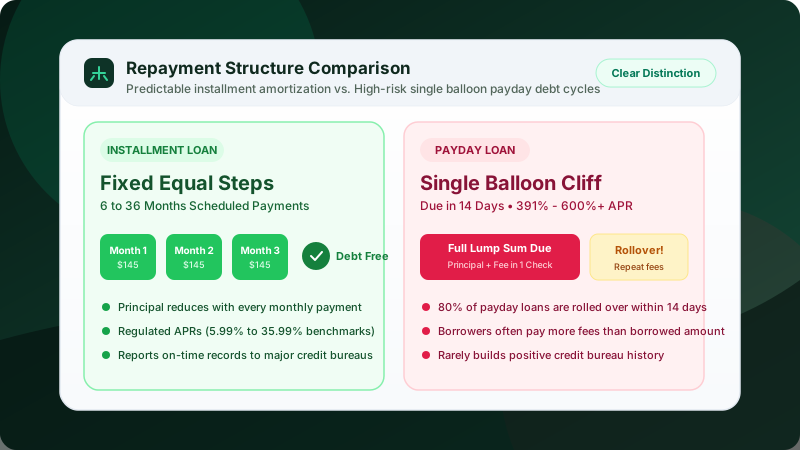
Personal Installment Loans: You borrow a fixed lump sum (typically $200 to $5,000+) and repay it over months or years (6 to 60 months) through equal monthly installments. Each payment automatically reduces a portion of the principal balance, ensuring that by the final payment date, your debt is completely paid off.
Payday Loans: You borrow a small sum (typically $100 to $500) that must be repaid in a single lump-sum balloon payment on your very next payday—usually within 14 to 30 days. Because the entire principal plus finance charges are due at once, many borrowers are unable to pay in full without depleting their paycheck for groceries and rent.
2. Side-by-Side Comparison Matrix
| Feature | Personal Installment Loan | Traditional Payday Loan |
|---|---|---|
| Repayment Structure | Equal monthly payments (principal + interest) | Single balloon lump sum due on next payday |
| Typical Terms | 6 to 60 months | 14 to 30 days |
| Borrowing Amounts | $200 to $5,000+ | $100 to $500 (state capped) |
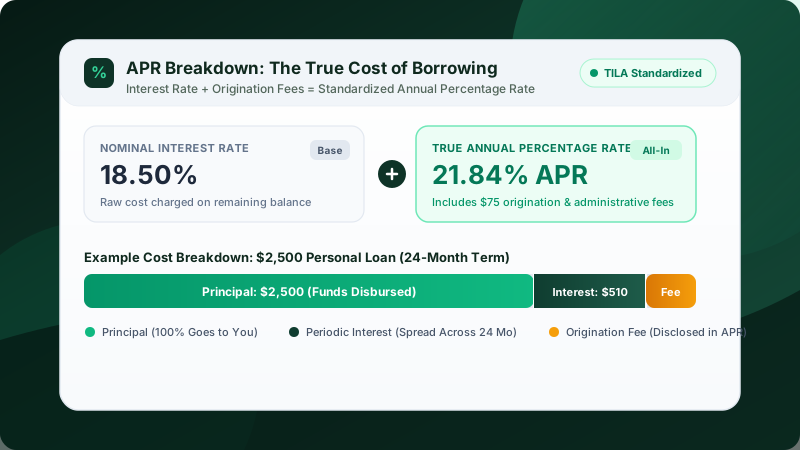
| Typical APR Range | 5.99% – 35.99% | 390% – 650%+ |
| Credit Bureau Reporting | Often reported (helps build positive history) | Rarely reported (only reported upon default/collection) |
| Prepayment Penalty | Generally none | Not applicable (short-term) |
3. The Dangerous Payday Rollover Cycle Explained
According to the Consumer Financial Protection Bureau (CFPB), more than 80% of payday loans are rolled over or followed by another loan within 14 days. This phenomenon is known as the payday debt trap:
- A consumer borrows $400 with a $60 fee due on payday.
- On payday, the lender automatically debits $460 from their checking account.
- Now short on cash to pay rent and food, the borrower immediately takes out another $400 payday loan with another $60 fee.
- After repeating this cycle 5 times, the borrower has paid $300 in fees alone and still owes the original $400 principal.
In contrast, installment loans eliminate this rollover mechanism by spreading repayment over a realistic timeframe, allowing borrowers to budget predictable monthly payments without losing an entire paycheck in one transaction.
4. Cost Comparison: Borrowing $1,000
Consider an illustrative scenario where an emergency requires $1,000 in immediate cash:
5. How Each Affects Your Credit History
Installment credit providers that report account performance to major credit bureaus (Equifax, Experian, TransUnion) provide an opportunity to build a documented history of on-time monthly payments. Over time, consistent on-time installment payments can strengthen your FICO score.
Conversely, payday lenders generally do not report regular payments to consumer bureaus. However, if you default on a payday loan, the account is routinely sent to aggressive collection agencies that do report delinquency, damaging your credit without ever offering the upside of credit building.
6. Which Option Makes Sense for Your Situation?
Before taking any loan, consider whether an installment loan aligns with your household budget:
- Choose an Installment Loan if: You need a loan amount larger than $500, require months rather than days to repay, want predictable equal payments, and wish to build documented credit history.
- Avoid Payday Loans whenever possible: The ultra-short terms and exorbitant annualized APRs create extreme financial strain. If you face an immediate cash crunch, contact creditors directly for payment extensions or consult a local credit union first.
Explore Transparent Installment Options
Review illustrative installment options with predictable monthly terms and transparent APR disclosures.